Written by: William Neal Mann and AI
Live edge woodworking has a certain magic to it. A raw slab carries its own personality — knots, curves, bark pockets, grain that shifts like smoke — and turning that into a finished piece doesn’t require a shop full of expensive machinery. What it does require is knowing which tools actually matter, which ones can wait, and how to stretch your dollars without sacrificing quality.
If you’re building tables, shelves, cutting boards, or small furniture on a budget, this guide lays out the essential tools that deliver the most value for the least cost. No hype. No unnecessary gear. Just the tools that earn their keep.
Why Live Edge Is Perfect for Budget Woodworkers
Live edge slabs do half the design work for you. The natural shape becomes the focal point, which means you don’t need elaborate joinery or complex milling equipment to create something beautiful. With the right basic tools, you can produce professional‑grade pieces that look like they came out of a high‑end studio.
The trick is choosing tools that pull double duty — tools that help you flatten, shape, sand, and finish without draining your wallet.
The Essential Tools (Budget‑Friendly Shopping List)
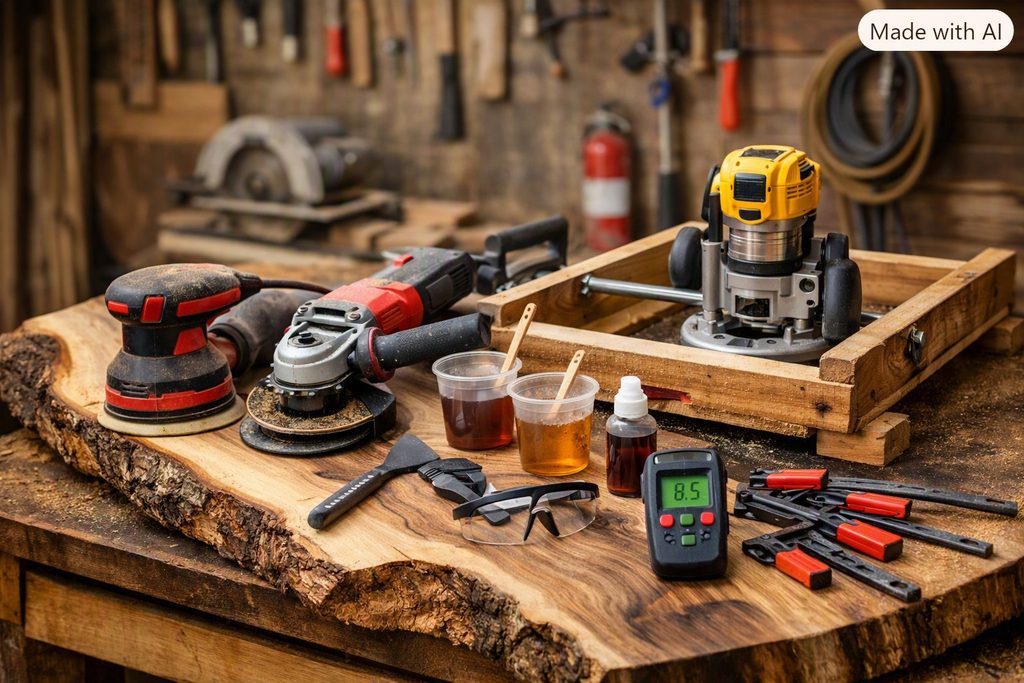
1. Random Orbital Sander (Your Workhorse)
If you buy only one power tool, make it this. Live edge slabs demand patient sanding, and a good orbital sander will save you hours of frustration.
Why it matters:
- Removes milling marks
- Levels small inconsistencies
- Prepares the slab for finish
Budget tip: A mid‑range sander with variable speed is more than enough. Pair it with quality discs — cheap sandpaper is where money really gets wasted.
2. Angle Grinder with Wood-Shaping Discs
This is your bark‑removal, edge‑shaping, problem‑solving tool. An angle grinder lets you sculpt the natural edge without fighting it.
Why it matters:
- Removes loose bark cleanly
- Shapes uneven edges
- Smooths knots and voids
Budget tip: You don’t need a premium grinder. Spend your money on good shaping wheels — they make all the difference.
3. Straightedge + Router (Flattening on a Budget)
A full-size planer or drum sander is expensive. A router sled setup is not — and it can flatten any slab you throw at it.
Why it matters:
- Creates a perfectly flat surface
- Works on slabs too wide for planers
- Saves hundreds compared to big machines
Budget tip: Build your own sled from plywood. The router is the only real investment.
4. Clamps (More Important Than People Think)
Live edge slabs often need stabilization while sanding, flattening, or filling cracks. A handful of solid clamps will make your life easier.
Why it matters:
- Holds slabs steady
- Secures cauls for flattening
- Helps with glue-ups and epoxy work
Budget tip: You don’t need a dozen. Four to six good clamps will handle most projects.
5. Moisture Meter
This tiny tool prevents big mistakes. Wood that isn’t dry enough will warp, crack, or cup after you’ve already put in the work.
Why it matters:
- Confirms slab dryness
- Helps you avoid unstable boards
- Saves time, money, and frustration
Budget tip: Even inexpensive meters are accurate enough for woodworking.
6. Epoxy + Basic Filling Tools
Live edge slabs come with cracks, voids, and imperfections — that’s part of their charm. Epoxy lets you stabilize and highlight those features.
Why it matters:
- Fills voids and cracks
- Adds strength
- Creates a polished, professional look
Budget tip: Buy epoxy in smaller kits unless you’re doing river tables. A few spreaders and mixing cups are all you need.
7. A Reliable Circular Saw
You don’t need a table saw to break down slabs or trim ends. A circular saw with a straightedge guide will do the job cleanly.
Why it matters:
- Cuts slab ends square
- Trims boards to length
- Works for both rough and finish cuts
Budget tip: A basic corded saw is cheaper and often more powerful than battery models.
8. Safety Gear (Non‑Negotiable)
Live edge work kicks up dust, bark, and debris. Protect yourself — especially when grinding or routing.
Must‑haves:
- Eye protection
- Hearing protection
- Dust mask or respirator
Budget tip: Buy quality here. Your lungs and ears aren’t replaceable.
Tools You Don’t Need Right Away
A lot of beginners think they need a full shop to get started. You don’t. Here are tools you can skip until your business grows:
- Planer
- Jointer
- Drum sander
- Bandsaw
- Expensive dust collection
These tools are fantastic — eventually. But they’re not required to produce beautiful live edge pieces.
Where to Save and Where to Spend
Spend on:
- Sanding discs
- Epoxy
- Router bits
- Safety gear
Save on:
- Grinder
- Clamps
- Circular saw
- Router sled materials
The goal is simple: invest where quality directly affects your finished product, and save where performance doesn’t change much between budget and premium options.
Final Thoughts
Live edge woodworking doesn’t have to be expensive. With a handful of smart tool choices, you can build tables, shelves, cutting boards, and furniture that look like they came straight out of a custom studio. The beauty of live edge is that nature does the heavy lifting — your job is to refine it, stabilize it, and let the wood speak for itself.
Start with the essentials, upgrade as your projects grow, and enjoy the satisfaction of creating something raw, natural, and uniquely yours.
Leave a Reply